Wednesday, 14 December 2016

Christmas Crafts

With daily task lists as long as my arm around this time of year I have always found it helpful to have a collection of activities and crafts that the children can do by themselves. I put through occasional orders with Baker Ross, an online shop dedicated to selling art and craft products, particularly for children. They have great deals on their powder paint and air dry clay if you buy in bulk, and they last ages. So with Christmas preparations gearing up and presents needing to be bought, cakes being baked and cards to be wrote, house to be decorated and carol service performances to be rehearsed, I wanted some crafts to help occupy the children (and stop them from trying to make my Christmas cards for my Clever Little Scraps business). Here are some of my favourites:

Nativity lanterns that we will put battery candles in. They come in packs of 4, Mary with Jesus, Angels, Wise men and shepherds.


Mr Social has been taking some interest in the sewing and knitting that I do, so these cross stitch decorations seemed like a good introduction. My 7 and 6 year old have done these with little supervision whereas my independent 2 year old had to be coaxed into doing an alternative craft.


Cross stitch was a little hard for Mr Smiley (2) to handle but these wooden colouring decorations were perfect. He recognised the characters and happily sat colouring them in. He is an excellent colourer which we discovered recently and is able to stay within the lines remarkably well for his age.

Dotty Art nativity pictures I'm sure will be a hit. These are still in our to do pile, but having done some before I know this will be an independent craft. What kid doesn't like stickers!


In a bid to also kill two birds with one stone as the saying goes I have got these Christmas cards for the children to colour for special family members like their grandparents.

Another decoration craft, but one which I can class as Maths - recurring patterns, addition, multiplication, area...all done with pipe cleaners and beads.


Putting these alongside baking sessions involving gingerbread, peppermint creams, snowmen cupcakes and Christmas wreath pastries, we will be having a fun filled month.

Tuesday, 13 December 2016

What invention changed the world the most?

A tough question was posed in our history lesson recently. What invention changed the world the most? I wonder how you would answer this question.

My first thoughts landed on the wheel. Transportation, water wheels, motors and engines have all benefited from this simple design. Or what about communication technology? Telephones, televisions, radio, telegraph, internet all make pretty impressive inventions and are used daily by the young and the old, and communication is now instant. Or maybe the lightbulb? and not just the lightbulb but the infrastructure that is needed and used now to provide electricity for power. Mr Social thought the automobile was the greatest invention whereas Mr Cheeky was backing R2-D2.

Our history programme however put forward a very good argument for why the printing press is the invention that changed the world the most. Over in Germany, Johannes Gutenberg, used his skills as a goldsmith to create the first ever moveable printing press. Previously books, literature, instructions were all either wrote, carved, or sewn by hand. His invention brought books to the masses. Information could be recorded and passed on. A person's works and achievements could be recorded for other people to learn from and add to.

Here is a list of resources that you can use to discover more about Gutenberg's printing press.

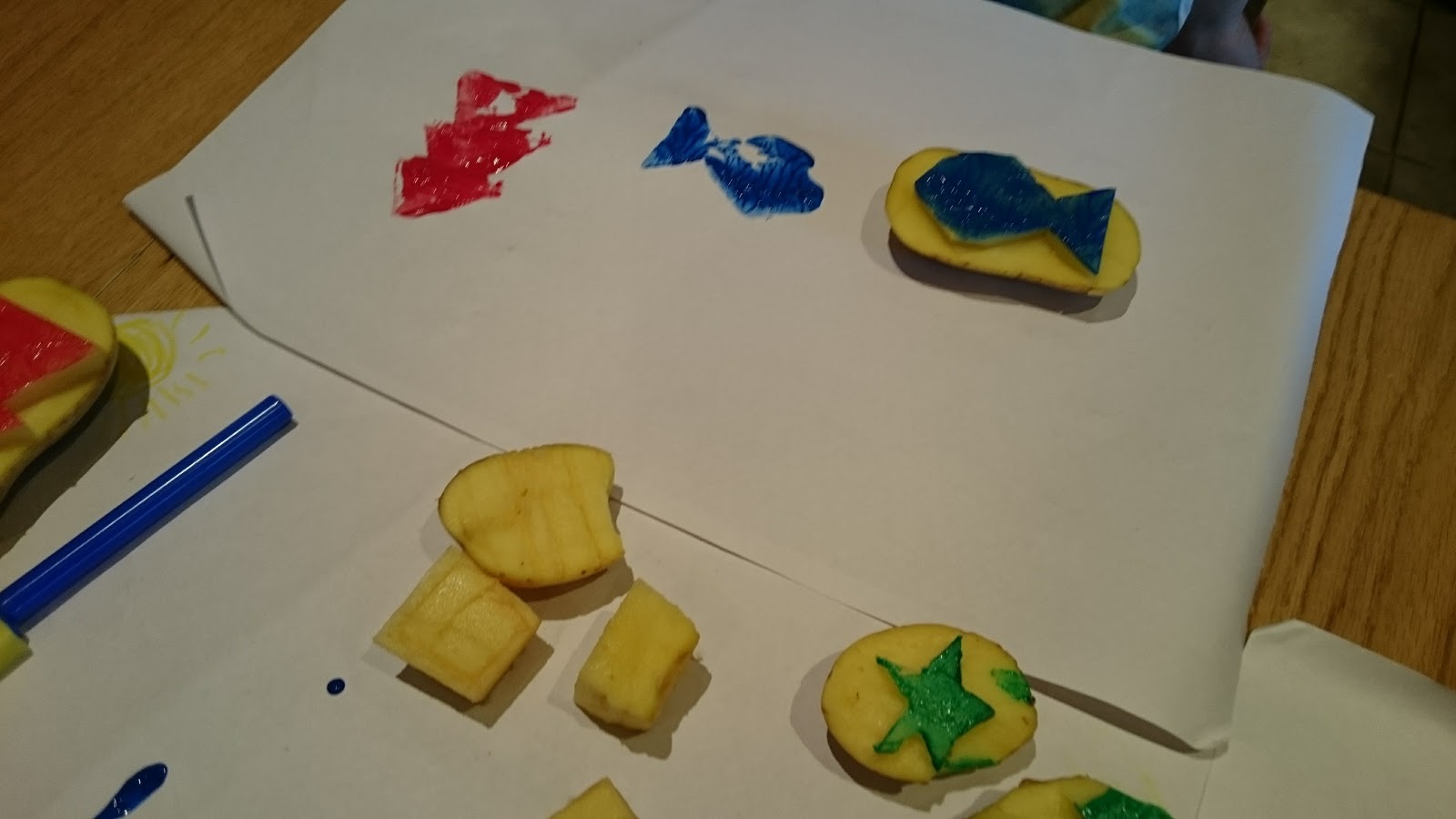
We decided to do some potato printing. I gave the children some potatoes that had been sliced in half and showed them how to carve their image on to the potato and had them cut around it. We stuck to fairly simple shapes and with some ready made paint and brushes they were good to go. Here are a few snaps from their printing endeavours.


As a side note we are quite a creative family and this activity is great for when you don't have suitable wrapping paper available. Stamp some fun images on some brown paper for your own personalised wrapping paper. Also for some more intricate potato designs you can use a metal cookie cutter hammered into the potato to create the shape for printing.

Thursday, 8 December 2016

Dinosaur Day at the Museum

This fascinating building is amongst the campus of the University of Liverpool. As a student I would often pass by it and not give it a second glance. Indeed, a number of my friends would often have lectures or take exams in the lecture theatres contained within. To the people of Liverpool they would often refer to this building as the red brick building. It is a hidden gem of the city as when I tell people that I have visited the Victoria Gallery & Museum I watch the blank look on their faces as they try and figure out where we have been. The VGM as some may call it now is a fascinating place and is located within this red brick building. We frequent the museum often and the staff are very welcoming and I have found them to be great with the children.

Every month they host a family Saturday where they will have a film showing in one of their lecture theatres in the morning and then after lunch they will have a craft related activity. Up until recently my boys favourite family Saturday was the showing of Charlotte's Web followed by a real petting zoo outside in the building's grounds...a personal favourite of mine too! But my budding engineers have a new favourite. Bring on dinosaur day!

The film was The Good Dinosaur (follow the link for some colouring pages). After lunch we got creative with some cardboard and created a 3d dinosaur.


But the best was yet to come...LEGO robotics! The LEGO mindstorm units were used to build these robots that were controlled using a handheld tablet. The app itself had a good interface and was simple to use even for my 2 1/2 year old. You could set the robots to respond immediately or you could pretend the robots were on the moon and a 3 second touch delay was set which made navigating them around the box became quite tricky.


The robots could be programmed to follow a path like this one below so basic coding skills could be learned through this fun play session.


One of the robots was even made to look like a dinosaur. Pretty cool!


I did come home and research the LEGO mindstorms range however at these prices as a one income family we have quite a bit of saving to do.

December family Saturday is Roald Dahl and his fabulous BFG and a teaching session with Roald Dahl's physician, Dr Tom Solomon. We are counting down the days.


Tuesday, 18 October 2016

African Masks

Our history lessons took us into the depths of Africa and being in a crafty mood we got out the glue, card, wooden sticks and tissue paper. A quick flick through google images as I introduced the boys to African masks and then to the table we went. My choice of craft items didn't scream Africa though so where to turn to but my kitchen cupboards of course and there I found dried beans...that's more like it. I was particularly impressed with Mr Social's mask, vibrant in colour and a good idea of the shapes and contours of the face.


Our history lessons come from Susan Wise Bauer's Story of the World.

Saturday, 8 October 2016

Solar Mechanics

Whilst on holiday recently we took the opportunity of visiting a renewable energy museum called CAT (Centre for Alternative Technology) in the north of Wales. I wasn't sure what to expect or how my children would view it or even what their understanding of the topics would be like. I'm fairly certain there were a lot of issues that the boys couldn't connect with as my eldest is still only just turned 7 but they explored the outside museum with open eyes and ready brains. I think most of the suggestions about energy saving measures you can take within the home were ignored, taps still run, lights are still left on and cars are still preferred to their feet (well at least for Mr Cheeky anyway). But the children were drawn to the lovely gardens, a dark walk-through mole hole and the wind and water energy models. We had rather fortuitously just completed the lesson on the sun in our Apologia science course on Astronomy and so when I came across a Solar Mechanics kit in the gift shop it really was a must have.


The kit is advertised as being for ages 8 and upwards but with a little parental instruction my 5 and 7 year old have got along just fine with the instructions and models. The purpose of the kit is to show children how solar cells can convert energy from sunlight into mechanical energy through a variety of models. The kit also instructs on some experiments that can be undertaken, for example altering the angle of the solar panel and seeing it's effect, or using different sources of light to power the models. We are half way through the models now and although I haven't captured them all by picture I did get a good recording of a solar powered car. 


Waiting in line to be tested is a knight robot, but our gloomy English weather and rain is preventing us from testing the robot. Solar powered fun rocks!

Friday, 7 October 2016

RSS Discovery


Liverpool received a visitor this past week in the form of a sea vessel. The RSS Discovery, a research ship belonging to the Natural Environment Research Council (NERC), was berthed by the cruise terminal for a few days and gave some members of the public the opportunity to get on board and look around her. The ship is reportedly said to have cost £75 million to build and equip and is packed with state of the art scientific equipment. It is said that 28 scientists and 24 crew members can comfortably take to the seas for up to 50 days at a time. The ship can carry out research relating to physical, biological and chemical oceanography, marine geology and geophysics, ocean engineering and atmospheric science.

So why am I telling you about a fancy boat? Because my 2 older boys got to go on it and have an exclusive look around. How cool is home education! Equipped with their exclusive passes they climbed aboard this research vessel and were shown around. They saw preserved marine life kept in jars from octopuses to angler fish. They got to see how thermal imaging cameras were used. They even got to sit in the captain's chair with the hat!

An excited duo returned, fresh faced and enthusiastic. They had just been on a human version of the Octopod. 

If you are interested in research and technology there is a second event happening in Manchester at the end of October and you can win a chance at viewing a research aircraft. Simply follow the link to the Into the Blue event page and follow instructions to be in with a chance.

Monday, 26 September 2016

Volcanoes on Venus experiment

Our studies into outer space have taken us to Venus. We soon learnt that the heat of the planet and the terrain made it a perfect planet for erupting volcanoes. We couldn't pass up on the opportunity to do a volcano experiment and there are quite a few to choose from. We settled on the flour experiment as I wanted to show the boys how the hot molten lava would cool and solidify.

Firstly we made our volcano by placing an empty ramekin upside down on a large plate and surrounded it with a mound of plain flour.


Next we melted some butter in a pan over a gentle heat and transferred it into a suitable pouring device...a trusty measuring jug. Slowly we took it in turns to pour our lava butter over the ramekin, allowing it to dribble and run onto the flour. 


Once all the butter had made it's own path through the flour we put it to one side and allowed the butter to cool. Once cooled the boys were allowed to touch the model and see how hard the butter had become. 


This was a very quick experiment and great for if you are short of time. I am still yet to make a fizzing painted model of a volcano but with a new baby in my arms I shall wait until nap times are more settled before I let the children loose with paints, paper mache and the bicarbonate of soda.